“Is it eSIM? Does it take two physical cards? Or one eSIM + one nano-SIM?” This is one of the most frequent questions in iPhone repair and resale — and the answer depends on both the model AND the region of purchase. A US iPhone has no SIM tray at all; a Chinese model takes two. This professional guide sorts it all out, with a model × region table.
KEY TAKEAWAYAn iPhone’s SIM configuration is
not set by the generation alone, but by the
regional variant (Axxxx number). To identify the region, see our article:
Axxxx model number & MPN code.
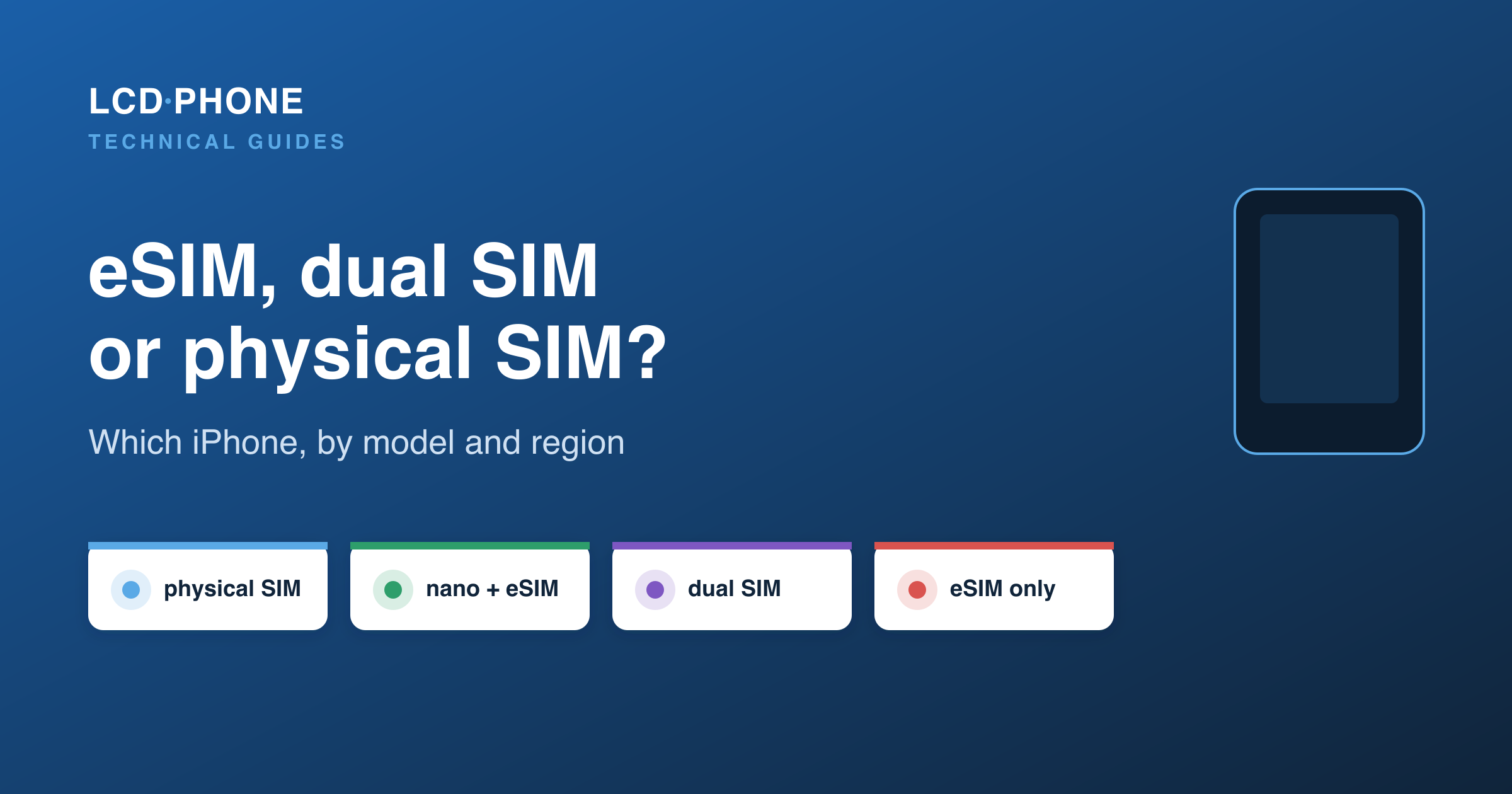
The 4 possible SIM configurations

| Configuration | What it means | Typical regions |
|---|
| Physical SIM only | 1 nano-SIM, no eSIM | Older iPhones (before XS) |
| 1 nano-SIM + 1 eSIM | “hybrid” dual SIM | International standard (Europe, incl. France) |
| Dual physical SIM (2 nano-SIM) | two physical cards, no eSIM | Mainland China, Hong Kong, Macao |
| eSIM only | no SIM tray | United States (14+), Japan (17+), + others |
The eSIM timeline on iPhone
| Year | Models | SIM milestone |
|---|
| 2018 | iPhone XS, XS Max, XR | First iPhones with eSIM: 1 physical nano-SIM + 1 eSIM |
| 2021 | iPhone 13 (whole range) | Support for two active eSIMs at once |
| 2022 | iPhone 14 — US versions | eSIM only, SIM tray removed (US models) |
| 2025 | iPhone 17 / 17 Pro / 17 Pro Max | “eSIM only” extended to 12 countries/regions including Japan, Canada, Mexico, Saudi Arabia. The iPhone 17 Air is eSIM only worldwide (China included). |
CRUCIAL POINT
Since the iPhone 14, all models sold in the United States are “eSIM only” (no SIM tray). And with the iPhone 17 series (2025), this group widens to 12 countries/regions, now including Japan, Canada, Mexico and Saudi Arabia. A customer who “can’t find the SIM slot” very likely has a US, Japanese or Canadian model: it is not a fault, there simply is no tray.
Table: SIM configuration by region
| Region of purchase | SIM configuration (recent generations) |
|---|
| France / Europe | 1 nano-SIM + 1 eSIM (and dual eSIM since the iPhone 13). SIM tray kept, including on the iPhone 17. |
| United States | eSIM only since the iPhone 14. No SIM tray. |
| Japan, Canada, Mexico, Saudi Arabia, Gulf states, Guam, US Virgin Islands | 1 nano-SIM + 1 eSIM up to the iPhone 16, then eSIM only from the iPhone 17 (2025). (Japan: forced camera shutter sound.) |
| Mainland China | Dual physical SIM (2 nano-SIM), no eSIM. Even the iPhone 17 / 17 Pro remain nano-SIM only there. Only the iPhone 17 Air is an exception (eSIM only). |
| Hong Kong & Macao | Dual physical SIM (2 nano-SIM) on many models; some recent models offer 1 nano-SIM + 1 eSIM. |
| iPhone 17 Air (all regions) | eSIM only, everywhere in the world — including Mainland China. No SIM tray. |
SIM CONFIG DEPENDS ON THE GENERATION, NOT JUST THE COUNTRY
Example: a Japanese or Canadian iPhone 15 Pro has a nano-SIM tray + eSIM, but a Japanese or Canadian iPhone 17 Pro is eSIM only. Always check via the Axxxx number of the specific generation.
Worked example: the iPhone 15 Pro, 4 SIM variants

Same phone, four SIM behaviours depending on the Axxxx number. Hence the value, on receiving a device, of reading the Axxxx number (see our identification guide) to tell the customer before even opening the device which SIM it can use.
Practical consequences for repair and resale
- No tray = no fault. On a US (14+) or Japanese (17+) iPhone, the missing SIM tray is normal. Do not look for a “SIM tray” part to order: there isn’t one.
- Targeted resale. A dual physical SIM model (China/HK) is valued by customers who want two physical cards. An eSIM-only model (US) may put off a customer used to a physical card: flag it explicitly at resale.
- Carrier compatibility. The eSIM must be supported by the customer’s carrier. In France the major carriers handle eSIM, but check for secondary carriers/MVNOs.
- Spare parts: the “SIM tray” flex and connector differ between tray and eSIM-only versions. Identify the variant (Axxxx) before ordering the part.
FAQ
From which iPhone is eSIM available?
Since the iPhone XS, XS Max and XR (2018): 1 physical nano-SIM + 1 eSIM. Dual eSIM (two active eSIMs) arrives with the iPhone 13 (2021).
Which iPhones are “eSIM only” (no physical card)?
The US models since the iPhone 14 (2022). With the iPhone 17 series (2025), “eSIM only” extends to 12 countries/regions: United States, Canada, Japan, Mexico, Saudi Arabia, Bahrain, Kuwait, Oman, Qatar, UAE, Guam, US Virgin Islands. The iPhone 17 Air is eSIM only worldwide. In Europe / France, iPhones (including the iPhone 17) keep a nano-SIM tray.
How do I know if an iPhone takes two physical SIM cards?
This applies to Mainland China, Hong Kong and Macao models (dual nano-SIM, no eSIM). It is identified via the Axxxx number (e.g. iPhone 15 Pro = A3104).
Does a US (eSIM-only) iPhone work in France?
Yes, if your carrier provides an eSIM (the case for major French carriers). However, it will never accept a physical SIM card: warn the customer.
Does Mainland China have eSIM on iPhone?
No across almost the whole range: Chinese models are dual physical SIM without eSIM, and even the iPhone 17 / 17 Pro sold in China remain nano-SIM only. The only exception is the iPhone 17 Air (eSIM only, China included).
Read first: Identify the version and origin of an iPhone: Axxxx model number and regional MPN code — to learn to read the Axxxx and the country code (FN, LL, ZD, CH…).






























 Quality Control: Test Screen and Battery Before FittingRead more
 How to Choose a Smartphone Spare Parts SupplierRead more
 Pay in 30 days with Billie: the guide to getting approvedRead more
 Courier delivery: Express 2 h in Paris and Aubervilliers, hourly departures to the near suburbsRead more
 Professional classified ads: sell your shop, hire, find your locationRead more