

Soft OLED, Hard OLED, In-Cell, disassembled or reconditioned original: 5 iPhone screen qualities, and as many choices for your repairs. Our team helps you see clearly.
Two main families
4 layers (glass, touch, display, backlight). Includes In-Cell, built like an LCD.
3 layers (glass, touch, self-emissive display). Comes as Soft OLED and Hard OLED.
👉 For the LCD vs OLED detail, see also: Difference between OEM, OLED and LCD screens.
The 5 iPhone screen qualities
Same structure as an LCD screen (4 layers). An economical alternative for compatible models.
Screen carefully removed from an iPhone: all components are original and fully functional. Any micro-scratch becomes invisible under tempered glass or a hydrogel film.
Original touch and components; only the glass has been replaced. Quality and performance remain identical to the original.
Flexible glass, very close to the original iPhone X screen. Absorbs shocks without breaking, excellent contrast and brightness, durability equal to the original — at a lower price.
Hard, rigid glass. Excellent contrast and brightness, at a more affordable price than Soft OLED.
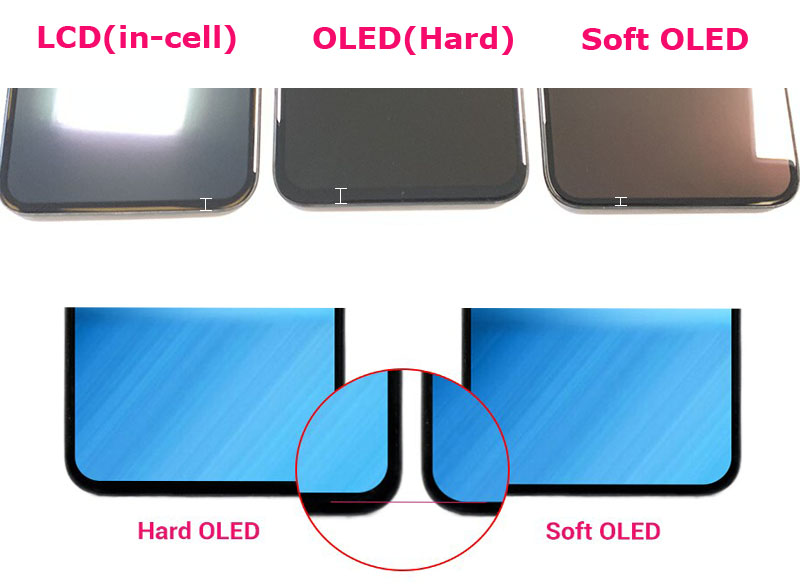
Soft OLED favours flexibility and shock resistance, closest to the original experience. Hard OLED, rigid, offers excellent rendering at a more affordable price. Edge size differs by type — a useful cue for the trained eye.